
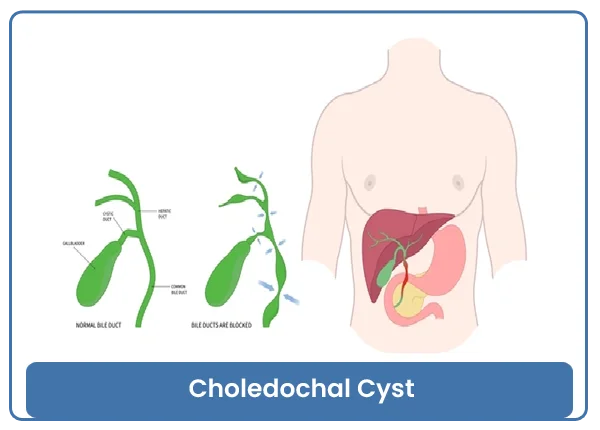
Choledochal Cyst
A choledochal cyst is a congenital (present from birth) dilation or enlargement of the bile ducts. The bile ducts are the tubes that carry bile from the liver to the small intestine for digestion. The exact cause of choledochal cysts is not well understood, but they are believed to result from a developmental abnormality in the bile ducts during fetal development.
Choledochal cysts are classified into several types based on their location and shape. The most common types include:
-
Type I - Dilatation of the common bile duct: This is the most common type and involves dilation of the entire common bile duct.
-
Type II - Dilatation of the common hepatic duct: In this type, only the common hepatic duct is dilated.
-
Type III - Dilatation of the common bile duct and the common hepatic duct: Both the common bile duct and common hepatic duct are dilated.
-
Type IV - Multiple dilatations of the intrahepatic and extrahepatic bile ducts: This type involves dilation of both intrahepatic (inside the liver) and extrahepatic (outside the liver) bile ducts.
-
Type V - Caroli disease: This is characterized by segmental dilatation of intrahepatic ducts and is a separate entity from choledochal cysts.
Choledochal cysts can cause various complications, including obstruction of bile flow, infection, pancreatitis, and an increased risk of developing cancer in the bile ducts. The most common symptoms include abdominal pain, jaundice (yellowing of the skin and eyes), and an abdominal mass.
Treatment typically involves surgical removal of the cyst to prevent complications and reduce the risk of cancer. The type of surgery depends on the specific characteristics and location of the cyst. Regular follow-up is important to monitor for any potential long-term complications or recurrence.
Early detection and appropriate management are crucial to prevent complications associated with choledochal cysts. If you or someone you know is suspected to have a choledochal cyst or is experiencing symptoms, it is essential to consult with a healthcare professional for a thorough evaluation and appropriate management.
Category : Choledochal Cyst